
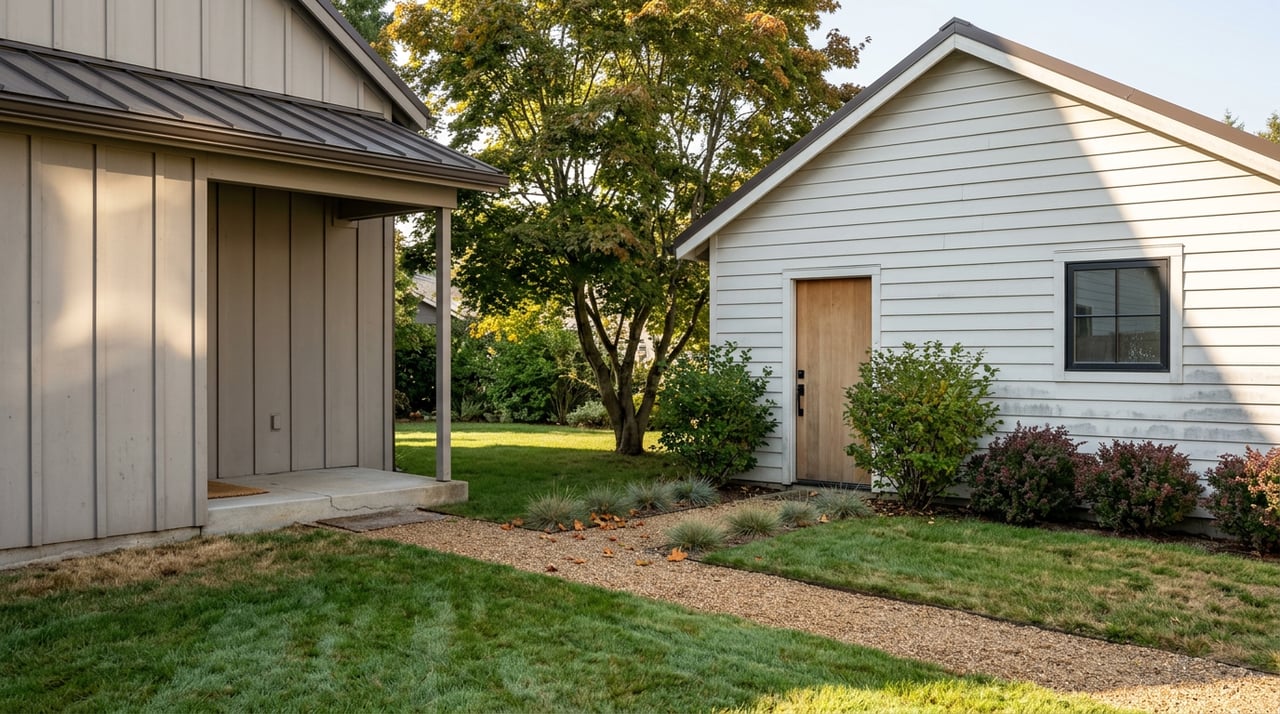
A buyer touring a home on Bozeman's west side this summer sees a detached studio behind the garage, already permitted as an accessory dwelling unit. The listing agent mentions it in passing. The buyer's mental math starts immediately: nightly rate, occupancy, maybe $30,000 a year toward the mortgage. Montana loosened its ADU rules a few years back, so this should be straightforward.
It isn't, and the reason has nothing to do with whether the ADU is legal. It is legal. The reason is that three separate rule-making bodies each got a vote on what that buyer can actually do with it, and only the first one said yes without conditions.
Montana's Senate Bill 245, passed in 2023, did something most states took years to get to: it stripped cities and counties of the ability to block ADUs outright. Every residential lot in the state is now eligible for at least one accessory dwelling unit as a matter of state law, and the legislation eliminated the owner-occupancy requirement that used to trip up investors. You no longer have to live in the primary home to rent out an ADU. You can, in fact, own the lot purely as an investment and rent both the main house and the ADU to separate tenants.
That is the part everyone quotes. It is also where the state's authority ends. SB 245 preempts municipal zoning, not private contracts. If the property sits inside a homeowners association, the HOA's covenants can still prohibit ADU construction, restrict its use, or ban short-term rentals entirely, and Montana law does not override that. A buyer who reads the SB 245 headline and skips the CC&Rs is skipping the one document most likely to actually control the outcome.
Building the ADU is the easy part now. Renting it the way most investors picture, as a nightly short-term rental booked through Airbnb or Vrbo, runs through a completely separate permitting system: the City of Bozeman's short-term rental ordinance, adopted as Ordinance 2149 in 2023.
That ordinance sorts every STR into one of four types, and the type determines whether an ADU rental plan is even legal.
| Type | What it covers | Host occupancy required |
|---|---|---|
| Type 1 | Room(s) in the host's primary residence, host present during the rental | Yes, host lives there full time during rental |
| Type 2A | Host's primary residence, rented out while the host is away | Host must occupy the dwelling as primary residence at least 70% of the calendar year |
| Type 2B | An ADU on the same lot as the host's primary residence, or one additional unit in the same building | Host must live in the primary residence on that lot, but does not need to be present during the ADU's rental period |
| Type 3 | An entire home that is not owner-occupied | New applications closed since December 14, 2023; only legacy permits active before that date can continue |
Type 2B is the pathway most ADU-as-income buyers actually need, and it comes with a condition that surprises people: the host has to live in the primary residence on that lot. You cannot buy a property, live somewhere else entirely, and run both the main house and the ADU as separate nightly rentals. Someone has to be home, at least in the legal sense of primary residence, for the ADU rental to qualify.
Type 3, the pure investment model where the whole property sits empty except for guests, has been closed to new entrants since the end of 2023. If a listing agent describes a property as having "STR income potential" without specifying which type applies, that phrase is doing a lot of unverified work.
The city's newly adopted development code adds one more wrinkle worth knowing before you assume a given lot works the way the last one did. Bozeman's City Commission adopted a full rewrite of its zoning code, Ordinance 2151, on December 16, 2025, and it took effect February 1, 2026. The rewrite replaced the entire prior zoning chapter and consolidated several of the old low-density districts into a new zone called RA. Under the new code, RA only allows Type 1 short-term rentals. Type 2 rentals, including the Type 2B path most ADU owners rely on, may no longer be permitted in that district at all. If a property that used to sit in R-S or R-1 now falls inside RA, its short-term rental options may have narrowed on February 1 whether the owner changed anything about the property itself.
Here is the detail that changes the return-on-investment conversation more than any of the licensing rules above. Bozeman began assessing impact fees on ADUs as of February 1, 2026, the same effective date as the new development code. Impact fees in Bozeman have existed since 1996 and were adjusted heading into 2026, but ADUs specifically were not subject to them before that date. A buyer running numbers on an ADU build based on last year's cost estimates from a contractor or a friend who did this in 2024 is working from a different fee schedule than the one that applies today.
This matters most for anyone treating the ADU as new construction rather than an existing, already-permitted unit. The impact fee applies at the point of building permit, on top of the usual planning review fees, building permit and plan check costs, and any septic or well permitting if the property is not on municipal utilities. None of those costs are large enough individually to kill a deal, but stacked together they shift the break-even point on the rental income side of the spreadsheet, and that shift landed earlier this year, not several years ago.
The short version: state law says you can build and rent an ADU almost anywhere in Montana. Bozeman's short-term rental ordinance says which of the four rental types your specific plan qualifies for. The new development code, effective February 1, 2026, may have moved your parcel into a district where that plan no longer works. And the fee schedule that applies to a new ADU build changed on that same date.
For a buyer eyeing a property because of its ADU or its ADU potential, the sequence that protects you is: check the zoning district under the post-February-1 map, confirm which STR type actually applies to how you plan to use the unit, and read the HOA documents before you read the marketing copy. A property with a legally built, currently registered ADU under a Legacy Type 3 or an active Type 2B permit is a very different asset than a lot that is merely zoned to allow one someday.
For a seller with an existing ADU, the registration status is the thing to have ready before your first showing. An unregistered short-term rental is a misdemeanor under city code, and buyers who are underwriting the property based on rental income will want to see the current permit, not just hear that the unit "could be" an Airbnb.
For an investor comparing several Bozeman parcels, the district each one falls into after the UDC rewrite matters more than the raw zoning label did a year ago. Two properties that looked interchangeable under the old code may now sit on opposite sides of the RA line, with very different short-term rental options attached.
None of this makes an ADU a bad idea in Bozeman. The city is a genuinely strong market for this kind of flexible-use property, and the state's preemption of local ADU bans is a real advantage compared to states where local zoning boards can still say no outright. The point is narrower: the headline about state law is the beginning of the analysis, not the end of it, and the gap between those two things is exactly where a rental-income assumption can quietly stop being true.
Does the new Unified Development Code change ADUs that were already built and permitted before February 1, 2026? Existing, already-permitted structures generally continue under the rules in place when they were approved, though a change in zoning district can still affect what you're allowed to do with the unit going forward, particularly around short-term rental type. Confirming current status with the city's planning department is the only way to know for certain on a specific parcel.
If my HOA doesn't mention ADUs at all in its covenants, am I in the clear? Silence in an HOA's CC&Rs is not the same as permission, and covenants can be amended. Reading the current governing documents and asking the association directly is worth the time before committing to an ADU-dependent purchase.
Is the 70% primary-residence threshold checked, or is it an honor system? It's tied to the permit application and renewal process, and the city's ordinance treats unregistered or non-compliant short-term rentals as a misdemeanor enforcement matter, not a formality.
If you're weighing a Bozeman property with an ADU already in place, or thinking through whether one makes sense to add, this is exactly the kind of layered question worth working through before you're under contract. Cheryl Ridgely has spent three decades reading Southwest Montana's zoning, permitting, and investment fine print so her clients don't have to learn it the hard way. Let's Connect.

Cheryl leads with passion and professionalism and specializes in second homes, vacation rentals, investment, commercial, and development properties. If you’re looking for local market knowledge and insight, connect with Cheryl as a trusted resource.
CHERYL RIDGELY
1805 W Dickerson St Bozeman, MT 59715